Your key decision is when to remove contingencies, and insurance should be settled before that moment. Have a licensed insurance broker seek a binding indication for the exact address, then review the real policy forms, flood coverage, renewal terms, and lender acceptance. If any answer is still missing, protect your deadline.
What Should Coastal Buyers Verify Before an Orange County Offer?
Before an Orange County offer on a coastal home, verify that an insurer will actually cover the exact address, what the full policy structure looks like if you need the California FAIR Plan plus supplemental coverage, whether flood is covered separately, and how renewal works. Get those answers in writing from a licensed insurance broker and your lender before you remove contingencies. Insurance availability can change what a home is worth to you.
Key Takeaways
The California Department of Insurance reported 677,449 FAIR Plan homeowner policies statewide as of October 2026, up 2,230 from July 2026, so buyers should expect the FAIR Plan to come up in coastal deals.
The FAIR Plan's residential limit is $3 million per location, and that limit has to be tested against the home's rebuild cost, not the purchase price or loan amount.
A FAIR Plan policy is not a standard homeowners policy, and the Department of Insurance says policyholders need separate coverage for items such as water damage and personal liability.
Flood and storm-surge exposure generally requires a separate National Flood Insurance Program or private flood policy, so check the waiting period and effective date.
Across the wider Laguna Beach market, all home types sold August to October 2026 averaged 95.6% of list price and 80% sold below list, which means insurance findings can be raised at the negotiating table.
I walk my coastal clients through insurance before they write an Orange County offer, because the answer can change the price you should pay or whether you should buy at all. A home can look perfect on the inspection report and still be hard to insure. Here's the order I recommend you work through it.
How Do You Confirm a Coastal Home Is Insurable Before Removing Contingencies?
Ask a licensed insurance broker or agent to seek a binding indication or a written underwriting decision for the exact address. A quote based on a ZIP code or neighborhood doesn't tell you whether an underwriter will accept the specific house you're about to buy.
What do underwriters look at on a coastal property?
Underwriting can turn on details a buyer rarely thinks about during a showing. Ask the broker whether any of these will affect eligibility, pricing, or conditions:
Roof age and condition
Electrical and plumbing systems
Prior losses and deferred maintenance
Vegetation or brush exposure, and proximity to slopes or canyons
Coastal weather exposure
Accessory structures, solar equipment, a pool, or short-term rental activity
A bluff-top home in Dana Point, a canyon-edge lot in Laguna Beach, and a harbor-side property in Newport Beach can each raise different questions. That's why the address matters more than the city.
What records should you gather?
Ask the seller for documentation on roof replacement, electrical work, plumbing upgrades, permitted improvements, and any prior mitigation. Roof, electrical, and plumbing are the big-ticket systems, and they can move both the insurance answer and your negotiating position at the same time. An insurer's objection to a system is a concrete, documentable issue to bring back to the seller.
For more on how property features affect premiums and eligibility, see my post on features that can drive up the cost of your homeowner's insurance.
What Does the California FAIR Plan Cover, and What Gaps Remain?
The California FAIR Plan is a last-resort option for applicants who can't obtain property insurance after shopping the voluntary market, and its residential coverage is not equivalent to a standard homeowners policy. Applications can go through a licensed property-insurance agent or broker, or directly to the FAIR Plan.
The California Department of Insurance has stated that FAIR Plan residential policyholders need separate coverage for items including water damage and personal-liability protection. The same release explains that a FAIR Plan policy may be paired with supplemental coverage, commonly called a Difference in Conditions (DIC) policy. Don't rely on the label "supplemental." Get the actual policy forms and read the exclusions.
What should you compare across each layer?
If your coverage ends up layered, you're comparing several documents, not one. Ask the broker to put each layer side by side:
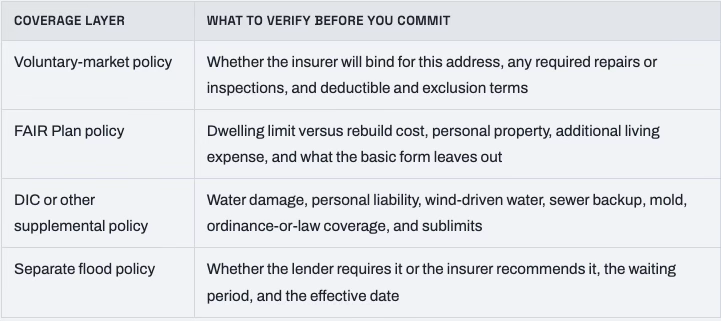
Coastal home insurance comparison chart showing four coverage options: standard homeowners insurance, California FAIR Plan, Difference in Conditions (DIC) supplemental coverage, and flood insurance, with key items buyers should verify before purchasing an Orange County home.
Is the replacement-cost limit enough?
The FAIR Plan's residential limit is $3 million per location. Confirm the current limit with the Department of Insurance, then ask how the dwelling replacement cost is calculated and whether extended or guaranteed replacement-cost protection is available. Rebuild cost can differ materially from your purchase price, the assessed value, or your loan amount, so don't assume any of those is the right number.
Does the FAIR Plan cover flood or storm surge?
No, it doesn't solve flood or coastal-flooding exposure on its own. Reporting that cites the Department of Insurance states that flood protection generally has to come from the National Flood Insurance Program or a private flood insurer. A property near the ocean, a harbor, a creek, or a low-lying drainage area may need its own flood analysis even if the homeowners quote looks fine. My post on buying a home in a flood-prone area covers the broader picture.
How Do Renewal Terms, Claim History, and Your Lender Affect the Decision?
Initial eligibility and renewal are two separate questions. A carrier's willingness to issue a policy today doesn't establish that it will renew on the same terms next year.
What should you ask about renewal?
Ask whether the quoted policy is subject to inspection, required repairs, a roof-age limitation, a protective-device requirement, a future underwriting review, or a change in deductible or exclusions. The SB 1301 legislative text describes a 75-day notice of nonrenewal and renewal offers generally delivered at least 45 days before expiration. Those are notice rules. They are not a guarantee of the same price or terms.
There's also a disaster-related protection. The Department of Insurance's November 2026 notice describes California Insurance Code section 675.1, under which an insurer must offer renewal for at least the next two annual renewal periods after a disaster-caused total loss to the primary insured structure, subject to statutory conditions. That's fact-specific. Don't assume it applies to an Orange County property without checking the disaster declaration, the loss circumstances, and the property's status.
Can the seller's claim history hurt you?
Yes, it can, so don't treat it as irrelevant. California's rules on prior claims are changing, and you need to check the version in effect when you transact. The September 2026 SB 1301 text addresses claims that were unpaid, within the deductible, not covered, or tied to a property no longer owned, and it also describes an exception involving repeated claims for the same damage, defect, or condition. The practical move is to get the insurer's underwriting position for your specific purchase.
Will your lender accept a layered arrangement?
Don't assume so. If your protection is FAIR Plan coverage plus DIC, flood, or another supplemental policy, send the complete documents to your lender and get written confirmation that the package satisfies its hazard-insurance requirements. Do it early, before the escrow timeline gets tight. Your escrow officer will also need the final evidence of insurance in time to close.
How Should Insurance Findings Shape Your Orange County Offer?
Build the insurance review into your Orange County offer timeline, and don't remove contingencies until the coverage picture is clear. Coordinate the deadline with your purchase agreement, lender conditions, inspection results, and escrow schedule. If coverage turns out to be unavailable, materially more restrictive, or different from what you expected, you need to know before the applicable deadline, not after.
What does the local market give you to work with?
Recent local market data for the wider Laguna Beach market shows a median sale price of $3,272,724 for all home types sold August to October 2026, with 87 homes sold. That is area-wide context, not a price expectation for any individual home. Those same sales averaged 95.6% of list price, 80% sold below list, and the market carried 5.4 months of supply. There were 146 homes for sale in Laguna Beach at the time of this data. Those conditions leave room to raise documented insurance problems with a seller, though every deal is different.
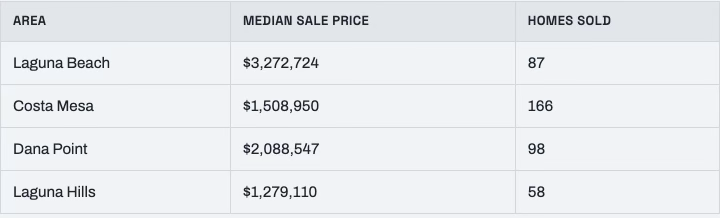
South Orange County housing market comparison showing median home sale prices and homes sold in Laguna Beach, Costa Mesa, Dana Point, and Laguna Hills from August through October 2026.
Source: aggregated public listing data, all home types sold August–October 2026, as of November 2026.
These are area-level medians, and a purchase price includes land. Your insurance question is about the structure's rebuild cost and the property's risk profile, which is a different calculation from price per square foot.
What should you ask for before you write the offer?
A binding indication or written underwriting decision for the exact address.
The complete policy forms and exclusions for every layer, including any FAIR Plan or DIC policy.
A separate flood determination and the flood policy's waiting period.
The insurer's replacement-cost calculation and your dwelling limit.
Written lender confirmation that the full insurance package is acceptable.
The seller's records on roof, electrical, plumbing, and permitted work.
For a broader checklist, my post on the top 10 things every home buyer should know before making an offer is a good companion. I also cover common errors in my post on home insurance purchasing mistakes.
FAQ
Can I get regular homeowners insurance before buying a coastal Orange County home?
Often you can start before you own the home, but availability depends on the specific property. Ask a licensed broker to seek a binding indication or written underwriting decision for the exact address during your due diligence. If the voluntary market declines, the broker can discuss the California FAIR Plan and supplemental options.
What happens if the insurer won't bind coverage before my escrow deadline?
Don't remove your contingency until you know where coverage stands. Your options depend on the exact language and dates in your purchase agreement, so contact me right away and we'll review it together. Your escrow officer and lender also need your insurance evidence in time to close.
Does the California FAIR Plan cover flood, storm surge, or water damage?
Not on its own. Flood protection generally has to come from the National Flood Insurance Program or a private flood insurer, and the Department of Insurance says FAIR Plan residential policyholders need separate coverage for items including water damage and personal liability. A DIC policy may fill some gaps, so read its exclusions closely.
Can the seller's prior insurance claims affect my ability to insure the property?
Yes, they can. California's rules on prior claims are changing, and the September 2026 SB 1301 text describes an exception involving repeated claims for the same damage, defect, or condition. Ask your broker for the insurer's underwriting position on your specific purchase rather than assuming the claim history doesn't matter.
Will my lender accept FAIR Plan coverage plus supplemental insurance?
Possibly, but get it confirmed in writing. Send your lender the complete policy documents for every layer and ask whether the package satisfies its hazard-insurance requirements. Do this before the escrow timeline gets critical.
The core takeaway is simple: confirm insurability, policy structure, flood exposure, and renewal terms before you remove contingencies. Your specific answer depends on the address, the home's condition, and your lender, and that's where I come in. If you're weighing a coastal purchase, I'll help you line up the right questions and timing before you commit. Get a free home valuation or search coastal listings with me here.
About Ronald “Ron” Pickett
Ron Pickett is an Orange County luxury Realtor and Dana Point coastal property expert, verified in the Top 1.5% nationwide by RealTrends (2023, 2025 & 2026). A retired firefighter and USMC veteran who served nine years as a fireman at MCAS El Toro, he built his background in mortgage lending and investment property before focusing on helping buyers and sellers across Orange County, where he has lived since 1993.
Coldwell Banker Realty · (949) 246-8500
Equal Housing Opportunity. Ron Pickett, CA DRE # 01379585; Coldwell Banker Realty, CA DRE # 00616212. Regulated by the California Department of Real Estate. This article is general information, not legal, tax, insurance, or financial advice; confirm your own numbers with your escrow officer, tax advisor, insurance broker, or lender.