
Coastal homeowners in Orange County face a shrinking private insurance market, stricter underwriting on roofs, wildfire exposure, and salt-air damage, and many end up on the CA FAIR Plan as a backstop. Understanding your options early, before escrow closes, is the key to protecting your investment.
Why is homeowners insurance so hard to get in Orange County coastal areas?
Coastal homeowners in Orange County are navigating one of the toughest insurance markets California has seen in decades. Insurers are scrutinizing roof age, wildfire proximity, salt-air exposure, and prior loss history more aggressively than ever, and many properties in Laguna Beach, Dana Point, Newport Beach, and similar communities are losing private-market coverage entirely. When that happens, the California FAIR Plan becomes the backstop, often paired with a separate liability or supplemental policy to fill the gaps standard coverage would normally include.
What's Driving the Insurance Crisis on the OC Coast
This isn't just a California problem, but California feels it sharply. The California Department of Insurance has tracked a significant rise in nonrenewal rates across the homeowners market through the early 2020s, and the California Department of Insurance has documented the FAIR Plan's growing exposure as more properties lose admitted-market options. By 2026, that pressure is very real for coastal Orange County owners.
Here's what insurers are looking at when they evaluate a coastal OC property:
Roof age and condition. An aging roof on a bluff-top home in Laguna Beach or a beachfront property in Dana Point is a major underwriting flag. Insurers want to know the material, age, and condition before they quote anything.
Wildfire and canyon proximity. Orange County's coastal canyons, especially the wildland-urban interface areas behind Laguna Beach and Aliso Viejo, push properties into higher wildfire-risk tiers. California law, per California Department of Insurance guidance, requires insurers to account for wildfire mitigation measures in their underwriting, which means documented defensible space and hardening features can genuinely move the needle.
Salt-air and coastal exposure. Distance to the ocean affects everything from exterior materials to foundation and drainage systems. Insurers know that a home sitting 200 feet from the water in Newport Beach ages differently than one a mile inland.
Prior claims and loss history. A property with recent water-intrusion claims, prior nonrenewals, or incomplete mitigation work is going to face a much harder placement process. That history can push a buyer straight toward the FAIR Plan before they've even closed escrow.
Plumbing, electrical, and HVAC updates. Older systems in beach communities draw scrutiny. Insurers want to see updates, and if they don't, premiums climb or coverage gets declined.
Recent Zillow market data shows the median sale price in Laguna Beach running around $3,350,000, with homes taking roughly 42 days to sell. At that price point, the cost of getting insurance wrong isn't a minor inconvenience. It can derail a closing or leave a buyer holding a seven-figure property with inadequate coverage.
The CA FAIR Plan: What It Is and What It Isn't
The California FAIR Plan Association is a state-mandated insurer of last resort. It exists specifically for property owners who cannot get coverage through the admitted private market. It is not a standard homeowners policy, and it was never designed to be one.
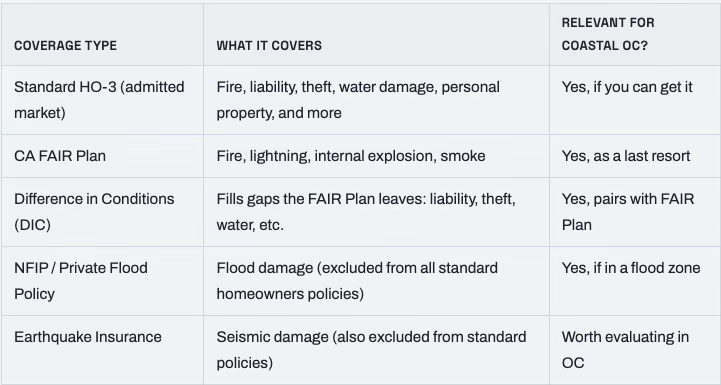
What the FAIR Plan typically covers: fire, lightning, internal explosion, and smoke. What it doesn't cover: liability, theft, water damage from plumbing, and a range of other perils that a standard HO-3 policy would include.
That's why most coastal homeowners who land on the FAIR Plan also need a separate "Difference in Conditions" (DIC) policy or supplemental coverage to fill those gaps. The combination can work, but it costs more and requires more coordination than a single admitted-market policy would. I walk my clients through this setup early in the process so there are no surprises at the closing table.
Flood Insurance Is a Separate Conversation
One of the most common misconceptions I hear from buyers new to the coast: they assume homeowners insurance covers flooding. It doesn't. Standard homeowners policies, including the FAIR Plan, exclude flood losses.
If a home sits in a flood-prone zone, a buyer may need a separate policy through the National Flood Insurance Program (NFIP) or a private flood insurer. FEMA flood maps are the starting point for determining whether a property falls in a Special Flood Hazard Area, and your lender will almost certainly require coverage if it does. In coastal Orange County, this is worth checking early, before you're deep into escrow.
How Insurance Affects the Buying and Selling Process
Insurance isn't just a post-closing task. In California, a lender will require proof of acceptable coverage before funding the loan. If a buyer can't secure that coverage, escrow can stall or collapse, depending on how the contract contingencies are written. I've seen deals in coastal communities hit serious turbulence because the buyer waited until the final week of escrow to start shopping for insurance, only to find out the property had a prior claim history that made placement nearly impossible on short notice.
Start shopping for insurance the moment you're in escrow, not after contingencies are removed. For more on what can slow down a closing, see my post on 5 issues that could delay your real estate closing.
What Sellers Need to Disclose
On the seller side, California's disclosure framework is specific. The Transfer Disclosure Statement (TDS) and the Seller Property Questionnaire (SPQ) are separate seller disclosure documents required in residential transactions, per California Association of REALTORS® standards. For coastal properties, these forms matter because prior insurance claims, nonrenewal notices, water intrusion history, roof condition, drainage issues, and HOA or maintenance concerns all belong in the disclosure package. Incomplete or inaccurate disclosures create liability for sellers and can blow up a deal in due diligence.
If you're selling a coastal home and you've had a prior claim or a nonrenewal notice, disclose it. Buyers will find out during underwriting anyway, and a surprise late in escrow is far more damaging than transparency upfront.
What Buyers Should Do Before They Offer
Here's the practical checklist I share with buyers looking at coastal Orange County properties:
Ask for the insurance history. Request prior claims, any nonrenewal notices, and current policy details from the seller. This is legitimate due-diligence information.
Check the FEMA flood map. Use the FEMA Flood Map Service Center to confirm whether the property is in a Special Flood Hazard Area.
Contact an independent insurance broker early. Not a captive agent, an independent broker who can shop multiple carriers and knows the coastal California market. Do this during your inspection period, not after.
Document property hardening and mitigation. If the home has a newer roof, updated plumbing, defensible space, or fire-resistant materials, document it. Per California Department of Insurance regulations, insurers are required to consider those factors, and they can improve your placement options.
Understand the FAIR Plan + DIC combination. If private-market placement isn't available, know what the FAIR Plan covers and what it doesn't, and budget for supplemental coverage accordingly.
Factor insurance costs into your offer math. A property that requires FAIR Plan plus supplemental coverage will carry higher annual insurance costs than a comparable home with admitted-market coverage. That affects your true cost of ownership.
For buyers who are still building out their overall homeownership strategy, my buyers' guide to homeownership covers the broader process from pre-approval through closing.
Every situation is different. The right combination of coverage depends on the specific property, its location, its condition, and what the admitted market will and won't write. That's exactly the kind of analysis where a local agent who knows these submarkets can point you in the right direction before you're locked into a contract.
Frequently Asked Questions
What is the California FAIR Plan and how does it work for beach homes?
The California FAIR Plan is a state-mandated insurer of last resort for properties that can't get coverage in the standard admitted market. For beach homes in Orange County, it typically provides fire, lightning, smoke, and internal explosion coverage, but it does not include liability, theft, or most water-damage perils. Most coastal homeowners who rely on the FAIR Plan pair it with a separate Difference in Conditions policy to fill those gaps.
Can I buy a home in Newport Beach or Laguna Beach if I can't get standard homeowners insurance?
Yes, but it requires more preparation. If a private-market policy isn't available, a FAIR Plan plus supplemental DIC coverage combination can satisfy most lenders' requirements, though you'll want to confirm that with your lender before you remove contingencies. The key is starting the insurance search during escrow, not after, so you have time to arrange acceptable coverage before the lender funds the loan.
Does flood insurance come with homeowners insurance in California?
No. Flood coverage is excluded from standard homeowners policies and from the CA FAIR Plan. If a coastal Orange County property sits in a designated flood zone, a separate policy through the National Flood Insurance Program or a private flood insurer is required. Your lender will mandate it if the home is in a Special Flood Hazard Area, and it's worth checking the FEMA Flood Map Service Center before you make an offer.
What insurance documents should the seller provide in escrow for a coastal home?
In a California transaction, the seller's primary disclosure obligations run through the Transfer Disclosure Statement (TDS) and the Seller Property Questionnaire (SPQ). Beyond those forms, buyers of coastal properties should also request the seller's current insurance declarations page, any prior claims history, and any nonrenewal notices received in the past few years. That information gives your insurance broker a head start and helps avoid surprises during underwriting.
What happens in escrow if the buyer can't get insurance before closing?
If a buyer can't secure acceptable coverage, the lender won't fund the loan, and escrow can't close. Depending on how the purchase contract is written, this can trigger a contingency dispute or, in the worst case, put the buyer's deposit at risk. This is why insurance shopping needs to happen during the inspection period, not in the final days before closing. For a broader look at what can stall a closing, see my post on 5 issues that could delay your real estate closing.
How do roof age and wildfire risk affect insurance on coastal properties?
Roof age is one of the first things an insurer checks on a coastal property. An older roof, especially on a bluff or canyon-adjacent home, can result in higher premiums, coverage limitations, or outright declination. Wildfire risk near Orange County's canyons adds another layer of scrutiny. California law requires insurers to factor in wildfire mitigation measures, per California Department of Insurance regulations, so documented defensible space, fire-resistant roofing, and updated systems can meaningfully improve your placement options.
The Bottom Line
Insurance on a coastal Orange County property is a real part of the transaction, not an afterthought. Whether you're buying in Dana Point, selling in Laguna Beach, or evaluating a bluff-top home in Newport Beach, the coverage picture needs to be understood before you're committed, not after.
I've worked through these situations with buyers and sellers across the coast, and the difference between a smooth closing and a last-minute scramble almost always comes down to how early the insurance conversation started. If you're buying or selling a coastal property and you want to talk through what the insurance landscape looks like for a specific home, I'm happy to walk you through it.
Search coastal listings or get a free home valuation at ronaldpickett.com.
About Ron Pickett
Ron Pickett is an Orange County luxury real estate agent with Coldwell Banker Realty, verified in the top 1.5% of agents nationwide by RealTrends in 2023, 2025, and 2026. A Dana Point resident since 1993, Ron specializes in coastal and bluff properties across Laguna Beach, Newport Beach, Dana Point, and the surrounding communities. He brings a background in mortgage lending, investment property acquisition, and nine years of service as a United States Marine Corps firefighter at MCAS El Toro to every transaction. Ron is a proud member of the California Association of REALTORS®, the National Association of REALTORS®, and the Laguna Board of REALTORS®. CA DRE # 01379585.
Coldwell Banker Realty · (949) 246-8500
Equal Housing Opportunity. Ron Pickett, CA DRE # 01379585, Coldwell Banker Realty CA DRE # 00616212, regulated by the California Department of Real Estate.
This article is general information only and does not constitute legal, tax, or financial advice. Confirm your specific coverage needs, costs, and contract terms with a licensed insurance professional, your lender, your attorney, and your escrow or closing officer.