New coastal construction in South Orange County remains limited by scarce land and California Coastal Commission constraints, but select developments in Dana Point, Laguna Niguel, and San Clemente offer real appreciation potential for investors who understand local zoning, disclosure requirements, and liquidity risks before committing.
Are South OC's new coastal developments a smart investment in 2026?
New coastal construction in South Orange County is genuinely limited, and that scarcity is exactly what makes each new development worth paying close attention to. For investors who understand the local planning constraints, California disclosure process, and the liquidity profile of high-price coastal product, select new builds in Dana Point, Laguna Niguel, and San Clemente can represent a compelling long-term opportunity, but only if you go in with eyes open.
The Market Context You Need Before You Invest
South Orange County's coastal land is largely built out. That's not a talking point, it's the structural reality that shapes every investment thesis here. When new product does come to market, it enters a supply-constrained environment where demand from both owner-occupants and investors is persistent.
According to the California Association of REALTORS®, Orange County recorded 1,869 closed home sales in June 2026, with a median sold price of $1,425,000, up from $1,385,000 in June 2025. Market time countywide was 41 days, with 3,930 active listings. Those are county-wide numbers, and the coastal premium pushes prices well above that median in the communities I work in every day.
In Laguna Beach specifically, recent Zillow market data shows a median sale price of $3,349,500, with homes averaging 45 days on market and 168 active listings as of August 2026. That's a market where new coastal product commands serious price points, and where a mispriced or poorly located new build will sit.
The takeaway: the county market is moving, but coastal product at the luxury end is its own micro-market. Pricing right and understanding what drives value at this level is not the same exercise as buying a tract home in Irvine.
Why New Coastal Supply Is So Constrained
Most of the South OC coastline is already developed. What new construction does appear comes through infill, teardown-rebuilds, or small planned communities carved out of remaining parcels. Virtually every coastal new build in Dana Point, San Clemente, or Laguna Niguel has to navigate California Coastal Commission review, which governs development within the coastal zone and can add significant time and cost to a project.
The City of San Clemente's General Plan Housing Element for 2021–2029 identifies housing inventory sites and development opportunities, but the pipeline is constrained by available land, zoning, and the pace of entitlement. That constraint is a feature for investors already in the market, not a bug. Limited new supply supports values over time.
For any new development you're considering, verify which stage it's at before you commit:
Pending permit approval
Under construction
Newly completed but unsold
Within an HOA (and if so, what the governing documents say)
Subject to coastal development permit conditions
Each of those stages carries different risk and timeline exposure. I walk my clients through exactly this checklist before we even discuss price.
What to Underwrite Before You Buy
New construction in a coastal zone isn't just a real estate transaction, it's a due-diligence exercise. Here's what I tell every investor looking at South OC coastal product:
Coastal zone restrictions and setbacks: View corridors, bluff setbacks, and public access easements can limit what you can do with the property and what future buyers will pay for it.
Geologic and stability issues: Coastal bluff properties in particular require a geology report. This isn't optional, it's the kind of thing that surfaces in inspections and can crater a resale if it wasn't addressed upfront.
Short-term rental limits: Dana Point and other South OC cities have enacted or are actively considering short-term rental ordinances. If your investment thesis depends on Airbnb or VRBO income, verify the current rules with the city directly before you close.
Insurance availability and premiums: Coastal and hillside properties in California have seen significant insurance market shifts. Get quotes before you're in escrow, not after.
HOA restrictions: Many new coastal developments come with HOAs that restrict rentals, exterior modifications, and parking. Read the CC&Rs before you make an offer.
Builder documentation: For new construction, confirm you have the builder addenda, warranty terms, completion timelines, punch-list procedures, and any special assessment language in writing. These are not standard resale documents and builders vary widely in how complete their packages are.
Don't overlook the big-ticket systems either. Even in new construction, HVAC specifications, electrical capacity, and structural elements can be your biggest negotiating leverage, and your biggest exposure if you skip the independent inspection because it's "brand new."
California Disclosures and Closing Process for Coastal New Builds
California has some of the most comprehensive seller disclosure requirements in the country, and they apply to new construction sales of 1–4 unit residential properties just as they do to resales.
Transfer Disclosure Statement and Seller Property Questionnaire
The Transfer Disclosure Statement (TDS) is the statutory California disclosure form required by the California Department of Real Estate for most 1–4 unit residential sales. It covers the seller's knowledge of the property's condition and any material defects. On a new build, the builder/seller completes this form.
The Seller Property Questionnaire (SPQ) is a separate disclosure form commonly used in California transactions, it's not a substitute for the TDS, but it surfaces issues and details that the TDS form alone may not capture. Both documents matter, and both should be reviewed carefully with your agent before you remove contingencies.
For coastal or hillside properties, additional disclosures around natural hazard zones, seismic risk, and flood designation are also standard. The California Association of REALTORS® publishes guidance on the full disclosure package buyers should expect in a California transaction.
Escrow Timeline on New Coastal Builds
Escrow on a new coastal development purchase typically opens after offer acceptance, then runs through buyer contingencies, lender underwriting, title review, and inspections before funding and recording. On a new build, the builder's contract often sets the timeline and may include non-standard addenda. Escrow timing can be affected by financing complexity, HOA document review, and title clearance, and coastal deals at the luxury price point often involve jumbo financing, which adds underwriting time.
If you want to understand what can slow a closing down, my post on 5 issues that could delay your real estate closing covers the most common friction points I see in transactions like these.
Documentary Transfer Tax
The documentary transfer tax in California is imposed on the transfer of real property and is collected by the county recorder at recording. In Orange County, the applicable tax treatment depends on local ordinance and the exact transfer structure, verify the current rate and who bears it with the Orange County Clerk-Recorder before closing. Who pays this cost is commonly negotiated between the parties; confirm the allocation in your own contract.
Liquidity Risk: The Factor Most Investors Underweight
High-price coastal product in South OC often takes longer to sell than more standardized inland product, especially when mortgage rates are elevated or inventory rises. This is a real risk that belongs in your underwriting. If you need to exit quickly, a $3M+ coastal new build is not the same liquidity profile as a $900K condo in Aliso Viejo. Plan your hold period accordingly, and make sure your debt service can absorb a longer-than-expected marketing period if conditions shift.
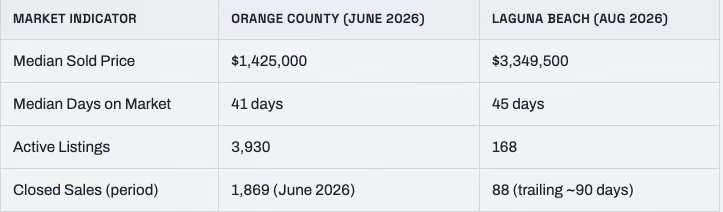
Sources: California Association of REALTORS® (Orange County, June 2026); recent Zillow market data (Laguna Beach, August 2026). Individual property values depend on condition, street, build year, and timing.
Every situation is different, and the only way to know whether a specific development pencils out for your goals is to run the numbers with someone who knows this market. That's exactly the conversation I have with investors before they commit to anything.
Frequently Asked Questions
How much new coastal housing is actually coming to South Orange County in 2026?
The pipeline is genuinely limited. South OC's coastline is largely built out, and new projects must navigate California Coastal Commission review, local zoning, and housing element constraints. What does come to market tends to be infill, teardown-rebuilds, or small planned communities, not large-scale tract development. That scarcity is part of what supports values in these markets over time.
Which South OC coastal cities have the most active development pipelines?
Dana Point, San Clemente, and parts of Laguna Niguel see the most consistent new construction activity among South OC coastal cities. San Clemente's General Plan Housing Element for 2021–2029 identifies specific development opportunity sites. Dana Point has seen new luxury infill and mixed-use projects near the harbor area. Each city has its own entitlement process and timeline, I track these markets closely and can tell you what's actually moving.
Are new-construction coastal homes in Orange County better for appreciation than resale homes?
Not automatically. New construction offers modern finishes, current building codes, and builder warranties, but appreciation depends on location, pricing at purchase, and how the broader coastal market performs. In a supply-constrained coastal market like South OC, a well-located new build can appreciate strongly. A new build that was overpriced at purchase in a rising-rate environment can underperform a well-priced resale. The fundamentals of location and entry price still dominate.
What disclosures does a California seller need to provide on a South OC coastal property?
For most 1–4 unit residential sales in California, the seller is required to provide a Transfer Disclosure Statement (TDS) and commonly also a Seller Property Questionnaire (SPQ). Coastal properties typically also require natural hazard zone disclosures, and may involve additional coastal-specific conditions depending on the property's location relative to the coastal zone. The California Department of Real Estate provides consumer guidance on required disclosures.
How long does escrow usually take for a new coastal development purchase in South OC?
Escrow timelines vary based on financing type, HOA document review, and the builder's contract terms. A cash purchase can close faster, but jumbo financing, common at South OC coastal price points, adds underwriting time. Builder contracts often include non-standard addenda and completion-contingent language that can extend the timeline. Budget more time than you would for a standard resale, and confirm the builder's expected schedule before you sign.
The Bottom Line
South OC coastal new construction is a real opportunity for investors who do the work upfront, understanding the planning constraints, the disclosure process, the liquidity profile, and what the builder's paperwork actually says. The supply side isn't getting dramatically easier, and that structural scarcity supports long-term values in the right locations.
I've been investing in and selling coastal Orange County properties for years, and I know which developments are worth your attention and which ones have issues that won't show up until you're already in escrow. If you're evaluating a specific project or want to understand what's actually in the pipeline right now, reach out and let's talk through it.
About Ron Pickett
Ron Pickett is an Orange County luxury real estate agent with Coldwell Banker Realty, verified Top 1.5% Nationwide by RealTrends in 2023, 2025, and 2026. A Dana Point resident since 1993, Ron specializes in coastal and investment properties across South Orange County, drawing on a background that spans nine years as a U.S. Marine Corps firefighter at MCAS El Toro, a career in mortgage lending, and years of personal investment in Newport Beach and surrounding coastal markets. He is a member of the California Association of REALTORS®, the National Association of REALTORS®, and the Laguna Board of REALTORS®. CA DRE # 01379585.
Coldwell Banker Realty · (949) 246-8500
This article is general information only and does not constitute legal, tax, or financial advice. Readers should confirm their own numbers and circumstances with a licensed attorney, tax advisor, lender, or escrow/closing officer. Equal Housing Opportunity. Ron Pickett CA DRE # 01379585; Coldwell Banker Realty CA DRE # 00616212. Regulated by the California Department of Real Estate.