Before you pay for a lower rate, work out how many months of payment savings it takes to recover the cost, then compare that to how long you'll realistically keep the loan. If the break-even is far out or the cash would leave you short after closing, keep the cash.
Should you pay points to lower your mortgage rate in Orange County?
Pay points only if you'll keep the loan well past the break-even point and still have healthy cash left after closing. To judge a mortgage rate in Orange County with points versus without, divide the upfront cost of the points by the monthly principal-and-interest savings, then compare the resulting number of months to how long you expect to hold the loan. If you might sell or refinance sooner, or the cash would leave you thin on reserves, keeping it is usually the stronger move.
Key Takeaways
Freddie Mac reported a national 30-year fixed-rate average of 7.24% and a 15-year average of 6.60% for the week ending October 29, 2026, but that survey is national and is not an Orange County loan quote.
Break-even months equal the upfront cost of the points divided by your monthly principal-and-interest savings, and if you sell or refinance before that month arrives, the points cost you money.
One discount point is generally 1% of the loan amount, but the rate reduction you get per point varies by lender, loan type, and borrower profile, so only same-day Loan Estimates tell you the real trade.
Points lower your principal-and-interest payment only, not property taxes, homeowners insurance, HOA dues, or maintenance.
As one local example, across the wider Laguna Beach, CA market, 81% of all home types sold July–September 2026 sold below list price, so asking for a seller credit toward your rate is a reasonable conversation to have.
How do national rates and Orange County prices shape the points decision?
Orange County loan balances are large, so each point is a bigger upfront payment here than in most of the country, which sharpens the trade-off between a lower payment and cash in your pocket.
For rate context, Freddie Mac's weekly survey put the national 30-year fixed average at 7.24% and the 15-year at 6.60% for the week ending October 29, 2026. That is a national average. Your quote depends on your credit, down payment, property type, occupancy, loan program, and lock period, which is why I never treat a headline rate as your rate.
For local price context, here is aggregated public listing data for two of the areas I work in. These are area-level medians, and an individual home's value depends on condition, street, build year, and timing.
Laguna Beach & Dana Point Market Snapshot - September 2026

Laguna Beach and Dana Point market snapshot showing three-month medan sale price ending September 2026 and September 2026 homes sold counts.
Source: Redfin calculations of MLS and/or public records. Median sale prices reflect the three months ending September 2026; homes sold are September 2026 counts.
Treat the Laguna Beach figure as wider-area context only, since it sits above the range of many homes I help clients buy and sell. What matters for this decision is how the market is behaving. Across the wider Laguna Beach, CA market, recent local market data for all home types sold July–September 2026 shows the average sale price at 96.1% of list price, 81% of homes selling below list, and 35% of listings taking a price cut averaging 5.8%. Months of supply came in at 5.4, down from 6.8 a year earlier.
That mix means there is often room to negotiate. Whether a seller will contribute toward your financing costs depends on the property and the offer, and limits on seller contributions vary by loan program, so confirm the rules with your lender before you write that into an offer. For countywide figures, the Orange County REALTORS market data page is the local association source I point clients to.
How do you calculate the break-even on discount points?
Divide what you pay for the points by how much your monthly principal-and-interest payment drops, and the answer is the number of months until the points have paid for themselves.
The simple break-even
Break-even months = upfront cost of points ÷ monthly principal-and-interest savings.
If the upfront cost works out to 60 times your monthly savings, your break-even is 60 months, or five years. Sell, refinance, or pay off the loan in month 40, and you paid for savings you never finished collecting. Keep the loan to month 100, and those extra months are real savings.
The time-adjusted break-even
The simple math ignores something important. Cash you keep today can sit in reserves, fix a roof, or cover a deductible, while savings from points trickle in over years. A more complete comparison discounts those future savings, which pushes your true break-even later than the simple number. If the simple break-even already looks long, the time-adjusted one will look longer.
How do you get a clean comparison from lenders?
Ask each lender for two same-day Loan Estimates: the same loan with zero points and the same loan with points. As the Consumer Financial Protection Bureau explains, lenders must disclose points and other loan terms on the Loan Estimate and Closing Disclosure. Keep these items identical across both scenarios:
Loan amount and term
Occupancy and property type
Credit assumptions
Lock period
Lender credits
Then compare the interest rate, the monthly principal-and-interest payment, total cash to close, and the five-year cost of borrowing.
One more check: make sure the charge is actually discount points. Fees labeled underwriting, processing, application, broker, or other origination charges are not rate buydowns, and the Closing Disclosure lists loan costs separately so you can tell them apart. Don't assume a fixed "quarter-point rate drop per point" either. The CFPB notes that the reduction varies by lender, loan type, market conditions, and borrower profile.
What should you compare points against before paying them?
Compare points against every other use of that cash, because the real question is not "does a lower rate help" but "is this the best use of this money." Whatever mortgage rate in Orange County you're quoted, the same dollars could go to closing, repairs, reserves, or a larger down payment.
Mortgage Points vs Keeping Cash: Buyer Decision Guide
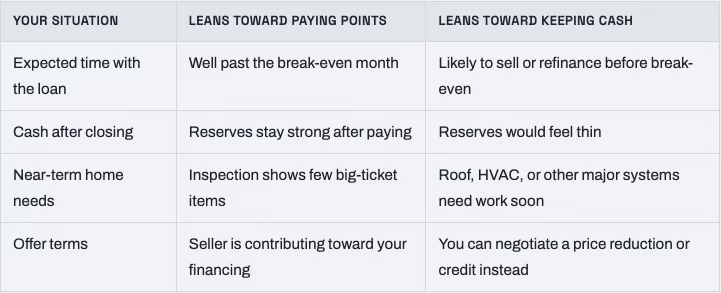
Comparison of when Orange County home buyers may benefit from paying mortgage points versus keeping cash, based on loan timeline, cash after closing, near-term home needs, and offer terms.
Cash for closing, repairs, and reserves
Your cash needs go beyond the down payment: the remaining closing balance, moving costs, immediate maintenance, insurance deductibles, and an emergency reserve. I'd rather see a buyer close with a slightly higher rate and a solid cushion than a perfect rate and an empty account. Big-ticket systems like HVAC are also where inspection findings give you real negotiating leverage, so think about whether a repair credit would do more for you than a lower rate. My post on understanding cash to close walks through what actually leaves your account at the table.
Points versus a larger down payment
A larger down payment shrinks the loan balance for the life of the loan, while points lower the rate on whatever balance remains. Neither is automatically better. Ask your lender to run both scenarios with the same total cash and compare the monthly payment and the cash you have left. If you're still deciding where your savings should sit before closing, I covered that in where to keep your down payment savings.
Lender credits are the reverse trade
A lender may offer a higher rate in exchange for a credit toward eligible closing costs. That's the mirror image of buying points, and it deserves the same break-even thinking: compare the credit, the higher payment, and your expected holding period using identical loan assumptions. Buyers using VA, FHA, or conventional financing should ask how that program treats points, credits, and seller contributions, since the rules differ.
Can the seller pay for your points?
Sometimes. A seller can offer a concession that you apply toward your financing costs, and it's negotiated like any other term in the offer. If you're building an offer, these questions to ask before making an offer will help you decide what to ask for and what to give up.
What about the tax deduction?
Don't buy points for the deduction alone. Per IRS Topic No. 504, points on a mortgage for your principal residence may be deductible in the year paid if you itemize and meet the IRS requirements, including that the points are clearly identified, you pay the funds at or before closing, the loan is secured by your main home, and the amount is customary for the area. Points that don't qualify for an immediate deduction are generally deducted over the loan term, as described in IRS Publication 936. The IRS, not your lender, decides eligibility, and the value depends on your own tax position, so confirm with your tax advisor before counting on it.
Points also lower only your principal-and-interest payment. Your property taxes, homeowners insurance, HOA dues, and maintenance stay exactly where they were, so a lower payment on paper doesn't mean a lower total housing bill.
FAQ
How many years do I need to stay in my Orange County home for points to pay off?
You need to keep the loan past your break-even month, and that number is different for every quote. Divide the points cost by your monthly principal-and-interest savings to get it. If you expect to sell or refinance before then, the points likely won't pay off.
How much does one mortgage point lower my payment?
It varies, and there is no universal quarter-point rule. One point is generally 1% of the loan amount, but the rate reduction depends on the lender, loan type, market conditions, and your profile. Compare two same-day Loan Estimates, with and without points, to see the actual payment difference.
Is it better to pay points or make a larger down payment in California?
It depends on your numbers, and the right answer comes from running both scenarios side by side. A larger down payment reduces the balance for the full loan term, while points reduce the rate on the remaining balance. Ask your lender to show the monthly payment and remaining cash for each option.
Can I negotiate points with a lender or have a seller pay them?
Yes on both fronts, within limits. Get quotes from more than one lender and compare their same-day offers, and consider asking for a seller contribution in your offer. Limits on seller contributions vary by loan program, so confirm what your lender allows before you write it into the contract.
Are mortgage points tax-deductible?
They may be, but not automatically. Under federal IRS rules, points on a loan for your principal residence can be deductible in the year paid if you itemize and meet the requirements, and otherwise they're generally deducted over the loan term. Have your tax advisor confirm how this applies to you, including any California treatment.
The bottom line on points and your cash
Points are a bet that you'll hold the loan long enough to win back what you paid, and that the cash won't be needed elsewhere first. Weighing a mortgage rate in Orange County against your timeline and your reserves is exactly the kind of decision I walk my clients through, and my background in mortgage lending helps me read those Loan Estimates line by line. Your escrow officer will show the final loan costs on the Closing Disclosure, but the smart time to run the numbers is before you write an offer.
If you're weighing a purchase, I'll help you build the offer and the cash plan together. Get a free home valuation or search coastal listings, and book a consultation to go through your numbers.
About Ron Pickett
Ronald “Ron” Pickett is an Orange County luxury Realtor and Dana Point and coastal property expert, verified in the Top 1.5% nationwide by RealTrends (2023, 2025 & 2026). A retired firefighter and USMC veteran who served nine years as a fireman at MCAS El Toro, Ron started in mortgage lending in 2003 and later turned to investment properties in Newport Beach and surrounding areas. He has lived in Orange County since 1993 and now makes his home in Dana Point.
Coldwell Banker Realty · (949) 246-8500
Equal Housing Opportunity. Ron Pickett, CA DRE # 01379585; Coldwell Banker Realty, CA DRE # 00616212. Regulated by the California Department of Real Estate. This article is general information, not legal, tax, or financial advice; confirm your own numbers with your escrow officer, tax advisor, or lender.