First-time buyers in Orange County need a full loan pre-approval before touring homes, a clear strategy for negotiating big-ticket items after inspection, and realistic timing expectations in a market where median sale prices sit around $1.27 million and homes typically sell within six to nine weeks.
What do first-time buyers need to know before purchasing a home in Orange County?
First-time buyers in Orange County face a market where the median sale price hovers around $1.27 million and homes routinely sell at or near list price. Success comes down to three things: arriving with a full loan pre-approval in hand, knowing exactly which items to negotiate after your inspection, and understanding the California escrow process so nothing blindsides you on the way to closing.
Orange County is not a market where you can figure things out as you go. I've watched buyers lose homes they loved because they showed up with a pre-qualification letter instead of a real pre-approval, or because they didn't know how to read the Transfer Disclosure Statement before making repair requests. This post walks you through what actually matters.
Pre-Approval, Pricing, and What You're Really Up Against
Let's start with the numbers, because they set the context for every decision you'll make.
According to Redfin's June 2026 Orange County market data, the median sale price countywide was $1,271,413, up roughly 2.5% year over year. Zillow's figures through July 31, 2026 put the typical home value at approximately $1.19 million, also up about 2.2% over the prior year. Both sources are pointing the same direction: prices are still climbing, just at a steadier pace than the frenzy years.
Here's where it gets sobering for first-time buyers. The Southern California Association of Governments' 2025 Orange County economic report, using September 2025 housing data, found that only 18% of first-time buyers could afford an entry-level home priced at $1,216,780, requiring a minimum qualifying income of roughly $241,800. That's the most detailed county-level affordability breakdown available as of August 2026, and it underscores why preparation is everything.
The price picture also varies dramatically by location within the county. Recent Zillow market data (trailing approximately 90 days, as of August 2026) shows the range across four of the areas I work most closely:
Orang County Home Price Comparison - August 2026
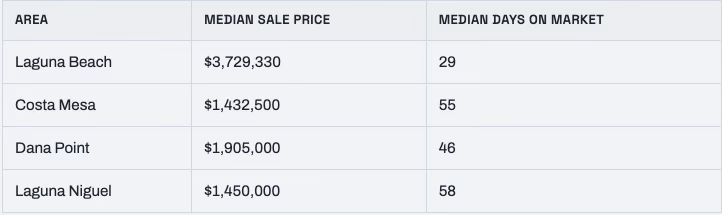
Orange County home price comparison showing median sale prices and median days on market for Laguna Beach, Costa Mesa, Dana Point, and Laguna Niguel in August 2026.
These are area-level medians. An individual home's value depends on its condition, street, build year, and timing. But the table gives you a real sense of the spread: a first-time buyer priced out of coastal Laguna Beach or Dana Point may find more options in Laguna Niguel or Costa Mesa, and inland communities like Aliso Viejo, Lake Forest, and Mission Viejo generally come in below the countywide median.
Why full pre-approval is non-negotiable here
I always tell first-time buyers to get fully pre-approved before they start touring homes, and in Orange County that advice carries extra weight. Listing agents at this price point expect to see a current pre-approval letter, or proof of funds for cash buyers, before they take an offer seriously. A pre-qualification, which is just a quick estimate based on what you tell a lender, won't cut it.
Full pre-approval means you've submitted your income documents, tax returns, bank statements, and debt information, and a lender has run your file through automated underwriting. The difference matters because it tells the seller you're a real buyer, not a tire-kicker. In multiple-offer situations, some buyers even include their DU or LP findings (the automated underwriting approval) as an additional signal of strength.
Both the National Association of REALTORS® and the California Association of REALTORS® emphasize this point specifically for competitive California markets. It's not just advice, it's table stakes here.
What to Negotiate and How the Escrow Process Works
The real negotiation levers for first-time buyers
According to Orange County REALTORS®' summary of C.A.R.'s February 2026 data, the sales-to-list price ratio in Orange County hit 100%, meaning many homes were selling at exactly list price. In January 2026, the ratio was 98.8%, per the same source. That tells you price negotiation on a well-priced, in-demand home is limited. Your real leverage usually comes after the inspection.
Here's where I focus my clients' energy:
Inspection-based repair requests or credits. After your general inspection, you can ask the seller to fix specific items, or request a credit toward your closing costs in lieu of repairs. Safety issues, roof condition, and major mechanical systems are the most defensible asks. A seller in a slower segment or with a home that's been sitting longer is more likely to negotiate here.
Big-ticket mechanical systems. The HVAC, water heater, electrical panel, and plumbing are your biggest negotiating leverage after an inspection. Don't overlook them in the excitement of finding a home you love. I've seen buyers save meaningful money by flagging a system that's at end of life and asking for a credit.
Contingencies. California purchase agreements typically include loan, appraisal, and inspection contingencies. In a multiple-offer situation, buyers sometimes shorten or waive contingencies to compete. That's a real risk, and it should be weighed carefully against the property's condition and your own financial cushion.
Closing date and rent-backs. If you can be flexible on timing, or if you can offer the seller a short rent-back period after closing, that flexibility can sometimes tip a close decision in your favor. Rent-back arrangements are structured in the California Residential Purchase Agreement and must comply with the terms agreed upon in writing.
Transfer tax and closing cost allocation. The documentary transfer tax in Orange County is governed by California Revenue and Taxation Code sections 11911 through 11929, administered by the Orange County Clerk-Recorder. Who pays it is not fixed by California law; it's negotiable in your purchase contract. Local custom in many Orange County transactions has the seller paying the county transfer tax, but that's practice, not a mandate, and it can shift by agreement. Escrow and title fee splits also vary. Frame all of it as customary but negotiable, and confirm the specifics in your contract.
Your specific negotiating position depends on the home's condition, how long it's been listed, and what else is competing for it. That's the kind of real-time read you can only get from someone who knows this market. If you want to know where you actually stand on a specific property, let's talk before you make an offer.
California disclosures: what to read before you remove contingencies
California requires sellers of most 1-4 unit residential properties to provide a Transfer Disclosure Statement, under California Civil Code sections 1102 through 1102.18, covering known material facts about the property's condition. In Orange County transactions using C.A.R. forms, you'll also typically receive a Seller Property Questionnaire, which asks more detailed questions about past insurance claims, unpermitted work, HOA issues, and neighborhood conditions. Neither document is something to skim. Read both carefully, flag anything that doesn't add up, and align your repair requests with what they reveal.
You'll also receive a Natural Hazard Disclosure report, which California requires under Civil Code section 1103 et seq., typically prepared by a third-party provider. It tells you whether the property sits in a designated fire, flood, or earthquake hazard zone. In Orange County, that matters, and it can affect your insurance costs and options.
The California Department of Real Estate's guide to disclosures in real property transactions is a solid reference if you want to understand the full disclosure framework before you're sitting in escrow.
How escrow actually works in Orange County
California residential transactions use a neutral escrow holder to receive your deposit, hold funds and documents, and coordinate closing. The California Department of Real Estate describes the escrow holder's role as facilitating the transaction without representing either party. For most conventional-financing transactions in Orange County, escrow runs 30 to 45 days, though well-qualified buyers with efficient lenders can sometimes close faster.
Here's the general sequence of milestones you'll move through:
Offer accepted; earnest money deposit sent to escrow.
Seller delivers TDS, SPQ, Natural Hazard Disclosure, and any other required disclosures.
Inspections completed within your inspection contingency window.
Appraisal ordered and completed (if you're financing).
Loan underwriting and final approval; you satisfy any lender conditions.
Contingency removals signed in writing using standard C.A.R. forms.
Final walk-through to verify the property's condition before closing.
Loan documents and closing documents signed; loan funds.
Grant deed recorded with the Orange County Recorder; escrow closes and you get your keys.
Each of those steps has a timeline attached to it. Missing a deadline, especially on contingency removal, can put your earnest money deposit at risk. I walk my clients through each milestone before we open escrow so nothing is a surprise.
Timing your purchase in 2026
Speed matters in this market, but it's not as extreme as 2021 or 2022. Federal Reserve Bank of St. Louis data for Orange County shows median days on market running 43 to 64 days in the first four months of 2026, with January at 64 days and February through April settling around 42 to 43 days. Those are the most recent FRED figures available as of August 19, 2026.
What that tells me is that buyers have more time than they did a few years ago, particularly in higher price brackets, but well-priced homes in desirable areas still move quickly. If a property has been sitting for longer than the local norm, that's worth paying attention to as a negotiating signal.
As for seasonal timing, summer tends to bring more inventory but also more competition. Fall and winter often mean fewer new listings but sellers who are more motivated. If you're curious about how off-season buying dynamics play out in Orange County specifically, I wrote about that in more detail in this post on buying during the off-season.
For a deeper look at the full homeownership process from a buyer's perspective, my two-part guide covers the broader picture: Part 1 and Part 2 are worth bookmarking before you start seriously touring homes.
Frequently Asked Questions
How much do I need to earn to afford a starter home in Orange County as a first-time buyer?
Based on late-2025 data from the Southern California Association of Governments, affording an entry-level home priced around $1.2 million in Orange County required a minimum qualifying income of approximately $241,800. That figure reflects September 2025 conditions and is the most detailed county-level breakdown available as of August 2026. Your actual qualifying income depends on your down payment, credit score, debt load, and the specific loan program you use, so verify with your lender directly.
Is full pre-approval really necessary before touring homes in Orange County, or is pre-qualification enough?
In Orange County's price range and competitive environment, full pre-approval is necessary, not optional. Listing agents routinely require a current pre-approval letter before they'll take an offer seriously, and a pre-qualification, which is just a quick estimate based on self-reported information, won't satisfy that requirement. Full pre-approval means your income, assets, and credit have been verified by a lender and run through automated underwriting, which puts you in a position to move quickly when you find the right home.
How long does escrow typically take in Orange County, and what happens during that time?
Most conventional-financing transactions in Orange County target a 30 to 45 day escrow period. During that time, you'll complete inspections, receive and review seller disclosures including the Transfer Disclosure Statement and Seller Property Questionnaire, get through the appraisal and loan underwriting process, remove contingencies in writing, do a final walk-through, and sign closing documents before the deed records with the Orange County Recorder. Cash buyers and highly qualified borrowers with efficient lenders can sometimes close faster.
Who pays the transfer tax and closing costs in Orange County, the buyer or the seller?
California law does not assign legal responsibility for the documentary transfer tax to either party, so it's negotiable in your purchase contract. Local custom in many Orange County transactions has the seller covering the county transfer tax, but that's practice, not a legal requirement, and it can be shifted by agreement. Escrow and title fee splits also vary by transaction and sometimes by city. Confirm every cost allocation in your specific contract rather than assuming a standard split applies.
How fast are homes selling in Orange County in 2026, and how quickly do I need to submit an offer?
Federal Reserve Bank of St. Louis data shows median days on market in Orange County running between 42 and 64 days in the first four months of 2026, with the pace quickening after January. Well-priced homes in high-demand areas can still attract multiple offers quickly, while homes in slower segments or at higher price points may sit longer. The practical answer is: if you find a home that checks your boxes, don't wait a week to decide. Have your pre-approval ready so you can move within a day or two of a property hitting the market.
The Bottom Line
Orange County's market in 2026 rewards preparation. Show up with a real pre-approval, know which items to push on after your inspection, read your disclosures carefully, and understand the escrow timeline before you're in the middle of it. Every situation is different, and the only way to know exactly what your position looks like on a specific property is to work through it with someone who knows this market.
If you're ready to get serious about buying your first home in Orange County, I'd be glad to walk through your situation and put together a plan. Search coastal listings or reach out to schedule a consultation and let's figure out where you stand.
About Ron Pickett
Ronald “Ron” Pickett is an Orange County luxury REALTOR® with Coldwell Banker Realty, verified as a Top 1.5% agent nationwide by RealTrends in 2023, 2025, and 2026. A Dana Point resident since 1993, Ron specializes in coastal and investment properties across Laguna Beach, Dana Point, Newport Beach, and the surrounding communities. His background spans nine years of service as a United States Marine Corps firefighter at MCAS El Toro, a career in mortgage lending, and years as a mobile notary and investment property owner, giving him a grounded, finance-forward perspective that he brings to every client transaction. Ron is a member of the California Association of REALTORS®, the National Association of REALTORS®, and the Laguna Board of REALTORS®. CA DRE # 01379585.
Coldwell Banker Realty · (949) 246-8500
This article is provided for general informational purposes only and does not constitute legal, tax, or financial advice. Readers should confirm their own costs, timelines, and transaction details with their attorney, tax advisor, lender, or escrow/closing officer. Equal Housing Opportunity. Ron Pickett CA DRE # 01379585; Coldwell Banker Realty CA DRE # 00616212. Regulated by the California Department of Real Estate.