Dana Point is drawing serious investor attention in 2026, driven by an ongoing harbor revitalization, a coastal lifestyle economy, and a median sale price of roughly $2.2 million that still undercuts neighboring Laguna Beach. The investment thesis is real, but it requires careful due diligence on rental regulations, operating costs, and construction timelines.
Is Dana Point the New Horizon for investment properties in 2026?
Dana Point the New Horizon for real estate investment is not just a tagline, it reflects a genuine shift in how serious investors are looking at the South Orange County coast. A multi-phase harbor revitalization, a coastal lifestyle economy anchored by beaches and boating, and a market pace of just 20 median days on market combine to make a compelling case. That said, the thesis requires real due diligence: rental regulations, operating costs, and an active construction timeline all shape what your returns actually look like.
Key Takeaways
Recent local market data puts Dana Point's median sale price at approximately $2,200,000, with homes selling in a median of just 20 days, the fastest pace among the major South OC coastal markets tracked here.
The Dana Point Harbor Revitalization has completed Phases 1–11 as of October 2026, with the overall project on track for completion in 2028, according to the OC Supervisor's project update.
Dana Point's median sale price sits well below neighboring Laguna Beach ($3,350,000), which means investors can access the same coastal corridor at a lower entry point while the area continues to develop.
Short-term rental regulations in California cities vary significantly, confirm Dana Point's current rules directly with the city before underwriting a vacation-rental strategy.
Proximity to Dana Point Harbor, Doheny State Beach, Strands Beach, and Salt Creek Beach creates a location story, but location alone does not prove cash flow, verify rent, insurance, and operating costs on each specific property.
Why are investors paying attention to Dana Point right now?
The short answer: a major public infrastructure project is still in progress, and history tells us that the most favorable entry points in a revitalizing coastal market tend to come before the ribbon-cutting, not after.
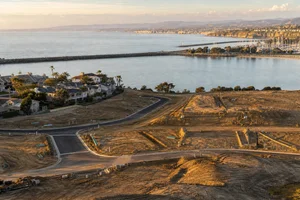
The Dana Point Harbor Revitalization Plan divides improvements into landside and waterside components, new retail, dining, marina upgrades, and public amenities that will reshape the harbor district entirely. According to a project update from OC Supervisor Katrina Foley, Phases 1–11 had been completed by October 2026, with the full project on track for a 2028 completion. That means investors who move now are still buying into a story that hasn't fully been told yet.
The city's coastal footprint adds to the appeal. According to the City of Dana Point's Economic Development office, the city spans nearly seven miles of coastal bluffs along the Pacific, roughly halfway between Los Angeles and San Diego. Doheny State Beach, Strands Beach, and Salt Creek Beach are all within the city, supporting a hospitality economy built around boating, surfing, dining, and coastal recreation.
That lifestyle infrastructure is what drives both short-term visitor demand and long-term residential desirability. It doesn't automatically guarantee returns, but it does establish the kind of demand floor that makes coastal investment defensible over time.
What does the current market actually look like?
Recent local market data tells a clear story. Dana Point's median sale price sits at approximately $2,200,000, and homes are moving in a median of just 20 days. For context, here's how that compares to other markets I work across South and coastal Orange County:
Dana Point & Orange County Investment Market Comparison - October 2026
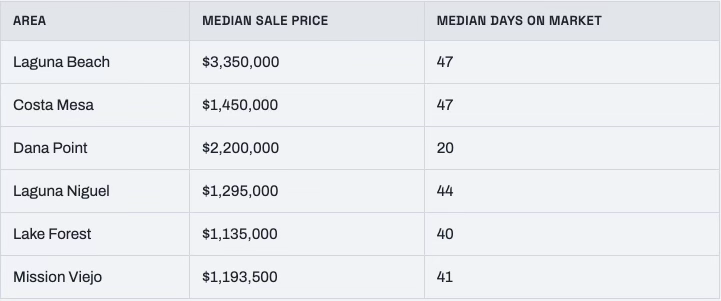
Orange County investment market comparison showing median sale prices and median days on market for Dana Point and five nearby cities in October 2026.
That 20-day median is striking. Dana Point is moving faster than every other market in this comparison, including Laguna Beach, which commands $1.1 million more at the median. That velocity tells me demand is outpacing supply right now, which is exactly the condition that tends to support price appreciation.
With 106 active listings and only 29 new listings in the last 30 days, inventory is tight. The Orange County REALTORS® market data tracks broader county-level trends that provide additional context, but at the local level, Dana Point's numbers speak for themselves.
What should investors actually evaluate before buying in Dana Point?
The location story and the revitalization timeline are compelling. But I walk every investor client through the same set of questions before we start writing offers, because the thesis has to survive contact with the actual numbers.
Rental strategy: long-term vs. short-term
Dana Point's hospitality economy and beach proximity make it a natural candidate for short-term vacation rentals. But short-term rental regulations in California cities vary significantly and change frequently. Before you underwrite a vacation-rental strategy, confirm Dana Point's current permitting rules directly with the city. A property that pencils beautifully as a short-term rental can look very different under long-term lease math, and you need to know which scenario you're actually buying into.
The CFPB's loan options guidance is also worth reviewing if you're financing an investment purchase, since lender requirements for investment properties differ from primary-residence financing in ways that affect your down payment, rate, and reserve requirements.
Property-level factors that matter more than the median
Dana Point's geography is not uniform. Coastal bluffs, rolling hills, harbor-adjacent flats, and inland neighborhoods all carry different characteristics. I tell investors to think carefully about elevation, views, beach access, walkability, parking, slope conditions, and coastal hazard exposure, because these factors can shift a property's rental appeal and insurance costs dramatically.
It's also worth remembering that proximity to a major destination cuts both ways. A property steps from the harbor benefits from foot traffic and lifestyle appeal, but proximity to a major destination cuts both ways, active construction noise, parking congestion, and seasonal crowd dynamics are real considerations during the harbor's remaining build-out through 2028.
Operating costs on coastal properties
Coastal properties carry costs that inland properties don't. Insurance premiums, including potential flood and wind coverage, can be materially higher. HOA fees in harbor-adjacent or bluff-top communities vary widely. Mello-Roos assessments exist in some Dana Point neighborhoods and should be confirmed on any specific property. None of these are deal-killers, but they all affect your actual net operating income, and the only way to run that number honestly is with property-specific data, not area medians.
Your specific numbers depend on the property's condition, location within the city, build year, and your financing structure. That's the conversation I have with every investor before we narrow down a target. Every situation is different, and the only way to know whether a specific property works is to run the actual numbers with someone who knows this market.
Timing the market vs. positioning ahead of it
With the harbor project on track for a 2028 completion, there's a reasonable argument that the best positioning window is now, before the full transformation is visible to every buyer scrolling listings from out of state. I've watched what happens to coastal markets after major public amenity projects finish: prices tend to reflect the completed vision, not the construction-phase discount.
That said, fall 2026 is also a point where inventory is thin and that 20-day median pace means competition is real. Buying during a quieter window can work in your favor, motivated sellers and reduced competition are real advantages, but in a market moving this fast, preparation matters more than timing. Being pre-approved and ready to move is not optional here.
The National Association of REALTORS® research consistently shows that coastal markets with major infrastructure investment tend to outperform comparable markets over multi-year holding periods. Dana Point fits that pattern, but the returns are not automatic, and the work of finding the right property at the right basis still matters enormously.
Frequently Asked Questions
Is Dana Point a good place to buy an investment property in 2026?
Dana Point presents a credible investment case in 2026, supported by an active harbor revitalization, a coastal lifestyle economy, and a market pace of just 20 median days on market. The investment thesis is real, but it depends heavily on property selection, rental strategy, and a clear-eyed view of operating costs including insurance, HOA fees, and any applicable Mello-Roos. I'd encourage any investor to run property-specific numbers rather than relying on area medians alone.
How will the Dana Point Harbor revitalization affect property values?
The harbor revitalization is one of the strongest structural arguments for Dana Point as an investment market. According to the OC Supervisor's project update, Phases 1–11 were complete as of October 2026, with the overall project on track for 2028. Major public amenity projects like this historically lift surrounding property values once complete, the opportunity for investors is that the market hasn't fully priced in the finished product yet. That window narrows as construction progresses.
Are short-term rentals allowed in Dana Point?
Short-term rental regulations in California cities vary significantly and are subject to change. Before underwriting any vacation-rental strategy in Dana Point, confirm the current permitting requirements directly with the City of Dana Point. A rental strategy that works under today's rules may look different if regulations tighten, building your underwriting around long-term lease income as a baseline is the more conservative approach.
How does Dana Point compare with Laguna Beach or Newport Beach for investors?
Dana Point's median sale price of approximately $2,200,000 sits well below Laguna Beach's $3,350,000 median, which means investors can access the same South OC coastal corridor at a lower entry point. Newport Beach carries even higher price points. The trade-off is that Laguna Beach and Newport Beach are fully established markets, while Dana Point is still mid-transformation, which creates both more upside potential and more execution risk. Your choice depends on your investment horizon, risk tolerance, and target return structure.
What risks should investors consider while the harbor revitalization is still under construction?
Active construction through 2028 means harbor-adjacent properties will experience noise, traffic, and disruption that can affect short-term rental appeal and daily livability. Insurance costs on coastal properties are rising across California, and flood or coastal hazard exposure should be evaluated on each specific parcel. Rental regulations could also shift during the holding period. None of these risks are unique to Dana Point, but they're all worth pricing into your underwriting before you commit, not after.
Dana Point the New Horizon for investment is a thesis worth taking seriously in 2026, and the market data backs it up. A $2.2 million median, a 20-day pace, and a harbor transformation still in progress add up to a window that won't stay open indefinitely. The work is in finding the right property, at the right basis, with a rental strategy that actually holds up under current regulations and real operating costs.
I live in Dana Point, I've invested in this coastal corridor, and I know this market at street level. If you want to talk through whether a specific property or strategy makes sense for your portfolio, reach out and let's run the numbers together.
About Ron Pickett
Ronald “Ron” Pickett is an Orange County luxury real estate agent with Coldwell Banker Realty, verified in the Top 1.5% Nationwide by RealTrends in 2023, 2025, and 2026. A Dana Point resident since 1993, Ron specializes in coastal and investment properties across Dana Point, Newport Beach, Laguna Beach, and the surrounding South OC communities. A retired firefighter and nine-year United States Marine Corps veteran, Ron began his career in mortgage lending in 2003 before shifting his focus to investment properties in Newport Beach and the broader coastal corridor, experience he brings directly to every investor client he works with today. He is a proud member of the California Association of Realtors, the National Association of Realtors, and the Laguna Board of Realtors.
Coldwell Banker Realty · (949) 246-8500
Equal Housing Opportunity. Ron Pickett CA DRE # 01379585; Coldwell Banker Realty CA DRE # 00616212, regulated by the California Department of Real Estate. This article is general information only and does not constitute legal, tax, or financial advice, confirm your specific numbers with your escrow officer, tax advisor, or lender before making any investment decision.