Interest rate changes reshape affordability, competition, and pricing power across Orange County. Rising rates compress buyer budgets and slow demand; falling rates unlock pent-up buyers and heat up competition. Understanding which direction rates are moving, and what it means for your specific situation, is the difference between a smart move and a costly one.
How do interest rate shifts affect Orange County buyers and sellers?
Interest rate changes directly alter what buyers can afford and how aggressively they compete, which in turn affects how quickly sellers can close and at what price. In a market like Orange County, where median prices in coastal areas like Laguna Beach hover around $3.4 million, even a half-point rate move can shift monthly payments by hundreds of dollars and push some buyers out of a price tier entirely. Whether you're buying or selling, the rate environment is one of the most important forces shaping your outcome right now.
What the Rate Environment Looks Like in 2026
Mortgage rates have been the defining story of the housing market for the past few years. After the aggressive rate-hiking cycle the Federal Reserve ran through 2022 and 2023, buyers and sellers across the country, and right here in Orange County, have been navigating a market that looks very different from the low-rate era that preceded it.
According to Freddie Mac's Primary Mortgage Market Survey, the 30-year fixed-rate mortgage has remained elevated compared to pre-2022 norms, though rates have pulled back meaningfully from their 2023 peaks. Every basis-point move matters here because Orange County prices are among the highest in the nation.
The California Association of REALTORS® tracks monthly affordability and sales activity statewide and has consistently shown that Southern California buyers face some of the steepest affordability headwinds in the country. That context matters when you're deciding whether to buy now, wait, or list.
Here's what the current rate environment means in practical terms for each side of the transaction.
For buyers: affordability math has changed
The most direct impact of higher rates is on your purchasing power. A buyer who qualified for a $1.2 million loan when rates were near 3% qualifies for significantly less at 6.5% or 7% on the same income. That's not a small gap, it can represent an entire property tier in a market like Newport Beach or Laguna Niguel.
What I tell buyers who are frustrated by this: the rate environment doesn't just affect your payment, it affects your competition. When rates rise, some buyers step back entirely. That means less bidding-war pressure, more time to conduct due diligence, and more leverage in negotiation. I've walked clients through offers in this environment where we negotiated concessions that would have been impossible in 2021.
The CFPB's mortgage rate explorer is a good starting point to understand how your credit score and loan type interact with current rates, but the real number that matters is the one your lender locks for you. Every buyer's situation is different, and the only way to know your actual purchasing power is to get pre-approved before you start touring homes.
For sellers: rate sensitivity reshapes your buyer pool
If you're selling in Orange County, the rate environment determines the depth of your buyer pool. When rates climb, some buyers pause. When rates dip even slightly, pent-up demand can release quickly and you may see multiple-offer situations return for well-priced properties.
In our coastal market, this dynamic plays out differently at different price points. Luxury buyers, those purchasing in Laguna Beach or Dana Point at $2 million and above, are often less rate-sensitive because they're bringing larger down payments or paying cash. According to the NAR REALTORS® Confidence Index, cash purchases have remained a meaningful share of transactions in high-end coastal markets, which partially insulates the luxury tier from rate swings.
But at the $800,000 to $1.5 million range, think Aliso Viejo, Laguna Hills, or Mission Viejo, rate sensitivity is real. A buyer financing $1 million at 7% is carrying a very different monthly obligation than at 5.5%. Price those homes wrong, and you'll feel it immediately in showing traffic.
In my experience working with sellers across OC, pricing right from day one is always the move, but it's especially critical when the buyer pool is rate-constrained. Chasing the market down after a stale listing is a much worse outcome than pricing accurately from the start.
Orange County Market Snapshot: Laguna Beach as a Benchmark
To ground this in real numbers: recent Zillow market data for Laguna Beach shows a median sale price of $3,395,000, with homes sitting on market a median of 41 days. There are currently 167 active listings, 34 new listings in the past 30 days, and 90 homes sold in the trailing 90-day period. That's a market that is moving, but not at a frenzied pace, which is consistent with an elevated-rate environment where buyers are more deliberate.
For context on what rate shifts mean at that price level, consider the table below. These figures illustrate the relationship between rate changes and monthly principal-and-interest payments at a typical Laguna Beach price point, not a quote or a guarantee, just the math that shapes buyer decision-making.
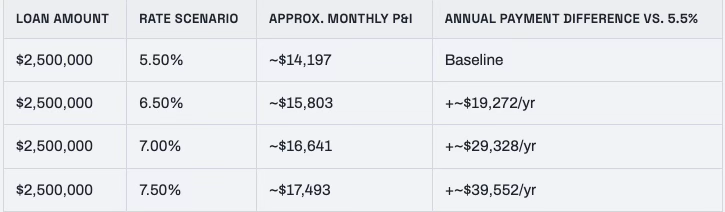
These are illustrative calculations only, your actual payment depends on your loan terms, lender, and closing date. Verify your own numbers with your lender. But the point is clear: a 1.5-point rate difference on a $2.5 million loan is nearly $40,000 per year. That's real money, and it's why rate movement matters so much to buyer demand at every price level.
Strategies for Buyers and Sellers in a Rate-Shifting Market
If you're buying
Get pre-approved first, not after. In a rate-sensitive market, knowing your exact ceiling before you start touring is non-negotiable. Rates can move between when you start looking and when you offer.
Understand rate lock windows. Most lenders offer 30- to 60-day rate locks. If you're in escrow, ask your lender about extended lock options, especially on a higher-priced OC property where a rate spike mid-escrow can genuinely affect your qualification. The CFPB's explanation of rate locks is a solid primer.
Consider adjustable-rate options carefully. ARMs can make sense for buyers who are confident in a shorter hold period, but they carry real risk if rates don't move the way you expect. The Federal Reserve's ARM consumer guide explains the mechanics clearly.
Don't wait for the "perfect" rate. Buyers who waited for rates to drop in 2023 and 2024 often found that when rates softened, prices moved back up quickly. The NAR's existing home sales data consistently shows that rate dips trigger demand surges, meaning competition returns fast.
Think about the fall and winter window. If you're reading this in mid-2026, the late-summer and fall period can be a smart time to move. I've written about what buyers and sellers should know about the winter market, motivated sellers and reduced competition often offset the rate environment in ways that work in a buyer's favor.
If you're selling
Price for the buyer pool that exists today. Online valuation tools don't account for rate-driven affordability compression. Your home's price needs to reflect what a qualified buyer can actually finance right now, not what a neighbor sold for in a different rate environment.
Consider offering seller concessions strategically. In a rate-sensitive market, some sellers have had success offering rate buydown concessions, where the seller contributes funds toward temporarily reducing the buyer's rate. This is a negotiable item that can make your property more competitive without necessarily cutting the list price. Discuss the mechanics with your agent and your escrow officer.
Know your hidden costs before you list. Rate shifts affect your net proceeds indirectly by affecting how long you sit on market and whether you end up in a price-reduction cycle. I'd recommend reading through these five hidden costs sellers often overlook before you set your list price strategy.
Understand your buyer's financing. When you receive an offer, your agent should be reviewing the pre-approval letter carefully. A buyer pre-approved at today's rates is a different risk profile than one pre-approved three months ago, rate locks expire and qualifications can shift. This is one reason financing issues are among the most common causes of closing delays.
The "lock-in effect" and what it means for OC inventory
One of the most underappreciated consequences of the rate environment is what economists at the Federal Housing Finance Agency have called the "lock-in effect": homeowners who refinanced at 2.5% to 3.5% during 2020 and 2021 are reluctant to sell and give up that rate. This has kept Orange County inventory lower than it would otherwise be, which has partially supported prices even as buyer demand softened.
For sellers, this is actually good news, your competition is limited. For buyers, it means the supply you're shopping isn't as deep as it looks on paper, and well-priced homes in desirable OC neighborhoods still move. The California Association of REALTORS® has tracked this constrained-inventory dynamic closely across Southern California markets throughout 2025 and into 2026.
Your specific situation, how long you've owned, what your current rate is, where you're moving, and what your timeline looks like, determines whether the lock-in effect applies to you. That's a conversation worth having before you decide to list or hold.
Frequently Asked Questions
Will Orange County home prices drop if interest rates stay high?
Not necessarily, and the OC market has demonstrated that repeatedly. Limited inventory, partly driven by the lock-in effect of owners holding low-rate mortgages, has kept supply constrained even as demand softened. Coastal areas like Laguna Beach and Dana Point have additional demand drivers that are largely rate-insensitive. Prices may flatten or soften modestly in rate-sensitive price tiers, but a broad price collapse isn't what the data has shown. The California Association of REALTORS® continues to track this balance monthly.
Is it better to buy now or wait for rates to drop in Orange County?
Waiting for rates to drop is a gamble, because rate dips historically trigger demand surges that push prices up quickly. In a supply-constrained market like OC, you can easily "win" on rate and "lose" on price. The better question is whether your finances, timeline, and target property make sense today, and that requires running your actual numbers with a lender, not waiting on a macro prediction. According to NAR's existing home sales research, pent-up buyer demand tends to release quickly when rates ease.
How do rate changes affect sellers in the OC luxury market?
Luxury buyers, those purchasing above $2 million in markets like Newport Beach or Laguna Beach, are often less rate-sensitive because cash purchases and large down payments are more common at that tier. That said, even luxury buyers financing a portion of their purchase feel the impact of rate moves on their overall cost. The NAR REALTORS® Confidence Index tracks cash-buyer share, which has remained elevated in high-end coastal markets.
What is a rate buydown and should OC sellers offer one?
A rate buydown is a seller concession where the seller contributes funds at closing to temporarily or permanently reduce the buyer's mortgage rate. It can make a property more attractive without a straight price reduction, and it directly addresses the affordability concern that rate-sensitive buyers face. Whether it makes sense for your listing depends on your price point, competition, and negotiating position, it's worth discussing with your agent as part of your overall pricing and marketing strategy.
What do rising rates mean for investment properties in Orange County?
For investors, rising rates compress cap rates and cash-on-cash returns on financed acquisitions. Properties that cash-flowed at 3% financing often don't pencil at 6.5% or 7% without a price adjustment. That said, Orange County's long-term appreciation history and rental demand remain strong, and cash buyers or those with significant equity in existing properties may find the current environment creates acquisition opportunities that weren't available in the low-rate, high-competition years. Every deal is different, run the numbers specific to the property before committing.
Interest rate shifts don't affect every buyer and seller the same way, and the right move depends entirely on your specific situation, price point, and timeline. If you're trying to figure out how the current rate environment affects what your Orange County home is worth, or what you can realistically buy, I'm happy to walk through it with you directly.
Get a free home valuation or search coastal Orange County listings here.
About Ron Pickett
Ron Pickett is an Orange County luxury real estate agent with Coldwell Banker Realty, verified in the Top 1.5% of agents nationwide by RealTrends in 2023, 2025, and 2026. A Dana Point resident since 1993, Ron specializes in coastal Orange County properties including Laguna Beach, Newport Beach, and the South County corridor. Before real estate, Ron served nine years in the United States Marine Corps as a firefighter at MCAS El Toro and later built a career in mortgage lending, giving him a ground-level understanding of financing that he brings to every buyer and seller he works with. He is a proud member of the California Association of REALTORS®, the National Association of REALTORS®, and the Laguna Board of REALTORS®. CA DRE # 01379585.
Coldwell Banker Realty · (949) 246-8500
Equal Housing Opportunity. Ron Pickett, CA DRE # 01379585; Coldwell Banker Realty, CA DRE # 00616212, regulated by the California Department of Real Estate. This article is general information only and does not constitute legal, tax, or financial advice. Confirm your specific costs, qualifications, and transaction details with your attorney, tax advisor, lender, or escrow officer.